
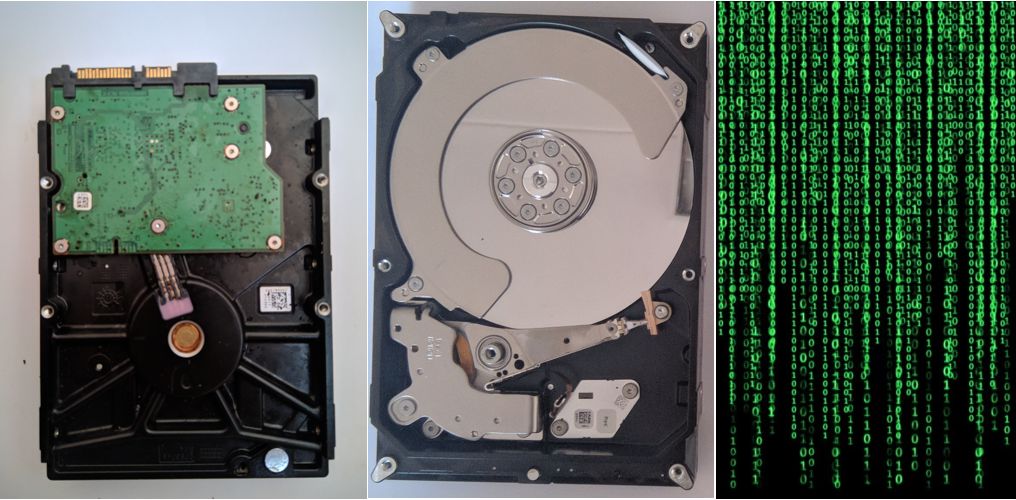
There are three types of failures:
- Electronic
- Mechanical
- Logical
However, most failures are usually complex. Often, even after fixing the mechanical issue, the data cannot be fully read (e.g., a damaged HDD head creates an unreadable “groove” on the disk), and further work requires manual effort to reconstruct complete files from raw “0”s and “1”.
Each of the mentioned types of failures can range from very simple to extremely complex. One might assume that logical (software-related) issues are the easiest to deal with, but in practice, automated tools often fail to deliver the desired results. Almost always, partitions and individual files must be manually reconstructed, which means analyzing hexadecimal code.
Meanwhile, what many imagine to be the most difficult task—replacing heads on an old ~40GB hard drive (assuming we have a suitable donor)—can take as little as 30 minutes.
Special attention is required for semiconductor drives (SSDs). Such drives, together with newer operating systems (“Windows 7,” “Windows 8,” “Windows 10,” and “Mac OS X”), activate the TRIM command when a file is deleted. This means the drive receives a “message” that the data is no longer needed, and the drive decides how to handle those storage blocks.
For these reasons, it is especially important to stop using the computer as soon as possible (for example, by cutting the power—if it’s a laptop, by holding down the power button).
We also have the capability in our lab to desolder chips and read data directly from them.
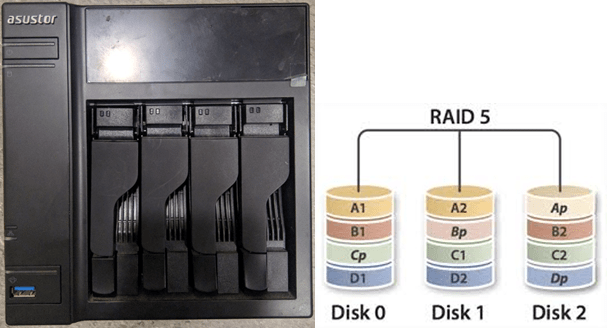
During data recovery, the storage devices are disassembled and the hard drives are inspected. If the drives raise any suspicion, see the previous section.
Almost always, storage systems use a RAID array. The most commonly used is RAID 5. In fact, it can be considered one of the more reliable configurations. However, in practice, when one disk fails—even though the system notifies about the failure—no one is usually in a hurry to replace it. Eventually, the next disk fails, and the data becomes inaccessible.
Strangely enough, this happens quite often because the disks are usually purchased at the same time and often come from the same batch, which may share the same defects. So if one disk fails, it is highly likely that another one will fail soon after.
When working with storage systems, we often handle truly massive amounts of data—usually over 6TB at a time. We always create disk images to ensure the data remains unchanged (and unharmed) until we complete the recovery process. Our laboratory server can store up to 300TB of data.
Our specialized hardware and software enable data recovery from damaged arrays, including:
RAID 1 mirror
RAID 2 stripe
RAID 4 stripe+parity disk
RAID 5 stripe+parity block
RAID 5E stripe+parity block+hotspare disk
RAID 5EE stripe+parity block+hotspare zones
RAID 6 stripe+parity block+RS code block
RAID 10 mirror+stripe
RAID 50 RAID’s 5 stripped
RAID 60 RAID’s 6 stripped
Diagnostics within 24 hours.
Coordination of the estimate
You only pay for the result!
Object delivery
If you are unable to deliver the item to us yourself, we can pick up the storage device directly from you anywhere in Lithuania. You can arrange courier services by contacting us via email at [email protected] or by phone at +370 656 41344
Diagnostics
Storage device failure diagnosis (usually within 24 hours). Determination of work scope and preparation of an estimate.
Data recovery
Repair of mechanical, electronic, and logical (software-related) failures (if any).
Return of recovered data
Recovered data is returned to you using the same or a different storage device, whenever possible. Recovered data is stored in our storage for 14 days.